Friday, July 17, 2009

Paris

After visiting Paris we certainly understand why it is known as a city of great beauty and romance. It was interesting to see how different this city is from any of those we saw in Spain. The city layout is very structured (in stark contrasts to the winding streets of Andalucia) and, when viewed from the top of one of its many monuments, appears to have a sense of symmetry. We kept ourselves busy, especially throughout the first few days, and managed to see many of the great museums, churches, historical buildings and monuments. 


We began our first day by meeting Mary Kay at our hotel. Considering the fact that we had just come from an over-night train and she from an over-night flight (without sleep and jet-lagged) we really crammed a lot into the first day. We visited the Holocaust Memorial, Notre Dame, walked around the the smaller island of the Seine, had a nice dinner and ice cream, went to the Shakespeare & Co. bookstore, and finished the evening with a boat tour of the Seine. The lac

y stained glass windows of the Notre Dame were especially impressive, as we had seen nothing like that in the cathedrals of Spain. The boat tour was a great way to begin our stay in Paris because it gave us a feeling for the city overall. It is incredible that so many impressive sites all lie within a single city. It's no wonder that half of France lives in Paris, though this makes it even more amazing that everywhere is so clean and beautiful.


For our second day in Paris we visited the Arc du Triomphe. We were impressed to realize how large this monument is. We climbed to the top, for our first panoramic view of the city. We walked along the Champs Elysees and enjoyed a bit of people-watching. We spent the afternoon in the Rodin Museum. This museum is in a old house where Rodin once lived; the house
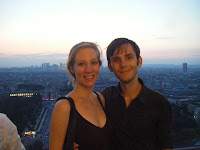
and gardens are beautiful alone and spectacular with Rodin's sculptures. It was fantastic to see some of Rodin's most well-known works, like The Thinker and The Burghers of Calais, along with smaller works that showed what an innovative artist he was. We walked around the surrounding area, past the Hopital d'Invalides. It's hard to believe that this palace-like, golden-domed building is basically the Parisian equivalent to a VA hospital. After having french onion soup and a quiche at a brasserie we went to the Eiffel Tower. Our timing could not have been better: we were able to ascend the tower just before sunset and stayed until dark, allowing us to have a fantastic view of the city during day and night. Interestingly, beneath the tower was some sort of concert/wake for the recently deceased Michael Jackson. We were somewhat shocked to learn that he had such an international following.


The next morning we visited the St. Chapelle Cathedral before checking out of our hotel. The walls seem to be composed more of stained glass than they are of stone; we enjoyed reading both German and Spanish descriptions of the windows. We

 then moved from our hotel to the apartment that we would be staying in for the remainder of the week. Having an apartment was a great idea because it allowed us to cook meals rather than always eating out and have a more comfortable place to relax. We were able to have more leisurely mornings and evenings and found a bakery called Bread and Roses that we fell in love with. The location was great: we were directly across the street from the Luxembourg gardens, so we had a great view and a great breeze. It also was a lot of fun to speculate about the people that normally lived in the apartment. We spent the afternoon in the Pompidou Center, which houses modern art, beginning with the post-impressionists such as Picasso and Matisse. The building itself is very contemporary; all of the pipes for water, air ducts, etc. are on the outside of the building rather than hidden behind walls, somewhat similar to the convention center in Houston.


Day 4. We spent several hours in the Musee d'Orsay, focusing especially on the floor of impressionist paintings. We took a scenic route back to the apartment when the museum closed, passing through an artsy area of the city that was filled with art galleries, fresh food markets, cafes, and boutiques. We had some of the most interesting ice cream & sorbet of the entire trip; the fresh mint ice cream was especially good! It was fun to see so many French people just getting off of work, chatting, shopping, and people-watching. 


On our fifth day in Paris we took a taxi to see the Sacre-Coure. The cathedral has an interesting history and is quite unique, but we found it much more attractive from a distance than when we actually ascended the hill. Perhaps the most exciting part of this experience was our taxi ride there. We had a female taxi driver who spoke a bit of English but had a deep, raspy voice and cursed about the traffic. She was very friendly to us and it was fantastic to see the city as we drove through it. 

That afternoon, we finally went to the Louvre! Just knowing that we were in such a world-renowned museum with so many masterpieces was wonderful. The old palace grounds alone are impressive and the glass pyramids in the center make it all seem somewhat ethereal. We were a bit annoyed by the fact that the museum was so full of people taking pictures of everything, but that wasn't enough of a distraction to take away from the art. It was great to be able to compare the artwork here to the many other museums we have visited throughout the summer and to be able to see why the Louvre is considered to have the greatest collection. Especially with the early Christian and Renaissance paintings, we were able to tell that even the lesser-known paintings here are superior those in many of the other museums we had seen. Unfortunately, the Louvre is so massive that it is overwhelming under any circumstance, but especially after having done so much sight-seeing in the past 6 weeks. We did see many of the greatest works: the Venus de Milo, the Winged Victory of Samothrace, and of course the Mona Lisa. We felt it appropriate to celebrate our day at the Louvre with a  fine French dinner. We did so at Chez Grammond's, a small restaurant down the street from our hotel. Chez Grammond and his wife have owned and operated this restaurant for 30 years and have never hired an employee. We read an article online praising the restaurant for having the freshest, most wholesome ingredients and traditional French cuisine. Sure enough, the tables were even decorated with wildflowers. It had a lot of character: the woman waited on us, wearing high heels and a The Doors t-shirt. She practically told us what we wanted to eat, but we were happy to agree. The food was delicious (especially Ian's duck and the Grand Marnier souffles)! There was only one other table filled and, as we were the last ones there, Chez Grammond himself came out to talk to us after closing the kitchen.


We were incredibly fortunate in terms of weather throughout the entire trip, especially considering the fact that rain was predicted nearly every day and we never really got rained on. However, we did choose a rather warm day to see Versaille. This palace undoubtedly outshines all those we had seen in Spain. Such extravagance! We decided to make it a bit more educational and listened to the audoguides in German and Spanish. The gardens are so large that it would take hours to see them all by foot, so we rented a golf cart and rode to a shady area in the back to eat the picnic we had brought with us. There happened to be some sort of military event going on at the time, so we even got to see small procession.


We finally decided we had seen enough museums and monuments and just wanted to walk around and BE in Paris. We walked around the Luxemburg gardens, sat and talked and ate crepes. Walking around the streets we saw the Observatory, an incredibly beautiful teaching hospital and the Sorbonne University. We did a little shopping (Lisa at a clothing store, Ian at the University's Philosophy bookstore). We saw a ballet in the Palais Garnier. This concert house is beautiful, and quite unique with a ceiling painted by Marc Chagall.


On our last full day in Paris we had a long brunch at our favorite Bread and Roses. We visited the Tulleries gardens, but found that we preferred the Luxemburg gardens. And we had another good French dinner, with a final order of Escargot.


On our final morning we went to a mass at St. Sulpice and got to hear a 30-minute organ concert afterwards. Cathedrals and organs certainly compliment one another to create a sublime feeling. Outside the church was a small ceramics market which was fun to browse. We had a picnic in the Luxemburg gardens before moving out of our apartment. We helped Mary Kay move into her new hotel and shared a final bottle of wine (and ice cream!). Then, it was finally time to head to the train station and board our 13-hour night train to Berlin.


Monday, July 6, 2009

Valencia - Week 4

We returned to Valencia by train and arrived Monday morning at 5 am. We began our final week of classes at 9 am. It was a busy week, because we had final exams.  We still managed to do a good amount of sightseeing though.


We visited the Museo de Bellas Artes, which contains an impressive collection of early Christian art and a few paintings by the great Spanish artists Velázquez, de Goya and El Greco. There was also a temporary exhibit of more contemporary Valencian artists. We were glad to see a few paintings by Sorolla, the impressionist artist famous for his paintings of the beaches of Valencia.


There was a film festival going on in Valencia, with films from directors throughout the world. We saw a series of short films by Valencian artists. Not all the films had subtitles, which created a bit of a barrier, but we enjoyed them nonetheless.


We also spent an evening at the beach. We shared a bottle of wine with two friends at a cafe on the boardwalk and walked along the shore for a while. It was too cool to go swimming, but it was really nice to see the beach at night.


Our stay in Valencia has been a wonderful experience.  Academically, we have developed a solid foundation in Spanish upon which we can continue to build in the future.  We received certificates at the completion of our course with our level, B2 on a scale from A1 to C2, C2 being the highest.  We were also able to feel at home in a foreign city by living and communicating with a family on a daily basis, taking in the culture, and visiting the top sites.

Thursday, July 2, 2009

Andalucia

After a quick, one-hour flight, we arrived in the enchanting city of Seville (Sevilla) o

n Thursday evening.  Our hotel had been around since 1914 and was run by a crippled, grumpy, but nevertheless kind old man.  The first night, we walked around the main part

s of town and struggled to navigate the narrow, curving streets, the names of which change every two blocks (if one can call them that).  We awoke, had an inexpensive breakfast o

n a nearby plaza, and quickly went to the largest cathedral in the world, La Catedral de Sevilla.  It had the first elliptical domed room as well as the (supposed) remains of Christopher Columbus. We found the sheer size of the building as well as its main tower to be the most impressive aspects.  The Giralda bell tower sits on a Roman foundation.  One can even read the latin inscriptions at its base.  The Muslims destroyed the original Roman church when they took over in the 8th century.  The majority of the tower was built by Muslims, but the Christians altered the top w

hen they replaced the mosque with the cathedral upon regaining power in the 13th century.  The muslim, red bricks of the tower are thus the only remaining part of the original mosque. For lunch we shared nine different tapas at a nearby restaurant.


Although one cannot deny the splendor and importance o

f the cathedral, what stood out to us most is the Alcazar, which is the Arabic word for palace. Interestingly, the Alcazar was built by Muslim architects for the Christian rulers yet contains minimal Christian architectural influence.  The layout of the palace seems to be without an organized system. Each time one enters a new room, one has the feeling of approaching a mysterious surprise. This overall feeling was most impressive, though the details of each room were incredible.


After spending an hour or so in the gardens, we decided to visit an important plaza on the other side of the city.  Not realizing how hot it had become, we thought we could walk . . . bad idea.  The temperature had risen to 105 degrees, which, during the day, remained constant in each of the three cities we visited.  We were therefore unable to make it as far as we wanted and headed back to the hotel to get ready for a flamenco show that evening.


We had heard that Seville was the best place to hear flamenco, of both improvisatory and "higher" types, and we were not disappointed.  We saw a one hour performance in a central courtyard of an attractive building decorated with typical Arabic tiles.  From the powerful technical mastery of the guitarist to the exotic allure of the dancers; from the foreign rhythms pounded out by the singer to his entrancingly dissonant voice - we could not have asked for a better spectacle.  We concluded our night by having sangria and a few more tapas at a restaurant near our hotel.


The next morning we had breakfast at the same cafe as well as churros (a sort of long, thin doughnut) with chocolate. We were lucky to catch the rapid train to Cordoba, a much smaller city. We were able to walk everywhere easily, though we still got lost in the narrow streets. The Mezquite of Cordoba is a strange mix of Muslim and Christian architecture. When the Christians conquered Cordoba they converted the center of the mosque into a beautiful cathedral, but left the rest as it was. The building is filled with seemingly endless columns and red arches, symbolizing infinity.


We walked around the old Jewish quarter and got lost in the heat, surrounded by white-washed walls and streets that dead-end without warning. We did manage to find the statues of Averroes and Maimonides, two philosophers Ian has studied recently.


We traveled to Granada for the evening and were thrilled to find that our hotel was located just off the main plaza, on the road with the sign directing travelers to the Alhambra. We arrived too late for the praised sunset, but we did have dinner with an incredible view. The restaurant we went to was located in a little street with no more than a little sign. We actually had to ring a doorbell and wait for it to be answered to enter the restaurant. We sat outdoors, on a patio that looked out at the Alhambra, with the snow-covered mountains of the Sierra Nevada as a backdrop. We ordered the tasting menu and were given more food than we could eat, all of it delicious! This included multiple courses of Spanish and international dishes, bred, wine, a dessert plate and coffee. Back at our hotel we found an attic room on the roof, and shared a bottle of wine with another impressive view of the city.


We rushed to the Alhambra in the morning. We really rushed (uphill, running, with backpacks) because we thought we were going to miss our thirty-minute reservation for entrance. Fortunately, we actually had a reservation for two hours later than we thought. This worked out just fine because it allowed us to tour the Generalife Gardens before entering the palace. It was cool to be in a place that was so old and has inspired so much poetry. The palace was beautiful, but we actually were more impressed by the palace in Sevilla.


We also visited the Capilla Real where the first king and queen of the Spanish empire, Ferdinand and Isabel, "the Catholic kings" were buried, along with their daughter Juana "la loca" and her husband Felipe "the beautiful". They chose Granada as their burial site because it was the last city of Spain to be re-conquered from the Moors. We had run out of energy for any more major tourist sites, but walked up the hill for one last view of the Alhambra. We sat in front of the church of San Nicolas on a bridge famous for its view of the palace. It was raining in the distance so we got to watch a patch of rain move over the countryside toward the mountains. We weren't able to stay late enough to see the reds of sunset, but the changing blues and grays have left a strong impression. This site also happens to be the hangout of a group of gypsies selling their hand crafts and playing flamenco guitar (singing and clapping included). The atmosphere was festive and we got a kick out of seeing their reaction to an approaching police car. One man yelled "agua" a few times and all the goods for sale disappeared. This was a great way to conclude our weekend trip, which will remain one of our favorite memories.

Wednesday, June 17, 2009

Weekend and Week 3

We spent a relaxing weekend here in Valencia exploring the city and trying to catch up on our homework. On Friday evening we went to one of the main squares in the historic district and tried agua de Valencia, one of the most popular beverages here comprised of orange juice, gin, vodka, champagne, and lots of sugar. On Saturday we visited the Palacio del Marqués de Dos Aguas, with its amazing alabaster facade and interesting ceramics collection. Our instructor called it a "mini Versaille", but we're hoping for more when we visit the actual Versaille in two weeks. It was most interesting to see traditional ceramics alongside modern works of art, including 5 plates by Picasso. We spent Sunday morning at the beach, reading on the shore and swimming in the Mediterranean. 


On Monday we watched a Spanish film after class entitled Los Amantes del Círculo Polar (Lovers of the Arctic Circle). It was beautiful, deep and thought-provoking, even without English subtitles. We particularly enjoyed getting to hear our instructor's interpretations of the film and talk about the symbolism.  We would definitely recommend this film to anyone. 


The same evening we attended Wagner's opera Das Rheingold at Valencia's Palau de les Arts Reina Sofia. In addition to impeccable singing (confirmed by an 

opera student who came with us), the choreography, costumes, and scenery corresponded to the architectural design of the building. That is to say, it was very modern, using three-dimensional technological effects, human bodies to represent gold and other material resources, and an outer space-like setting for the gods. It was well worth the price to get to experience a small part of the huge music festival that is taking place right now. People are coming from around the world to attend Wagner's cycle of operas entitled Der Ring des Nibelungen, as well as participate in concerts, and discussions.

We've also visited the Lladró factory, the only sight in the world where these valuable porcelain figures are handmade, and the Museum of las Fallas. Las Fallas is a festival held yearly in Valencia, of which Valencianos are extremely proud. Hundreds of giant paper-mache statues are constructed as part of a competition. At the conclusion of the week-long festival one is chosen as the winner and all the rest are burned. The museum contains the life-size figure that won for each year from 1930 to the present (except for the years during the Spanish Civil War). It was interesting to see how the emphasis on theme and designed changed over the years, especially after having just studied 20th century Spanish history. 

Tuesday, June 16, 2009

Valencia - Week 2

Our educational experience in Valencia has, to our surprise, been much richer than we anticipated at the beginning. Although we have been occupied with our daily classwork in addition to seeing the sights in Valencia - of course! - it has been helpful in a variety of areas. Our first class covers the history of Spain. . . that is, all of it. Our professor lectures over the historical events and artistic developments throughout the centuries. It has been particularly rewarding to understand the historical and symbolic significance behind many of the paintings and buildings we have thus far seen. In our second class of the day, we have been reading poetry by Bécquer and fragments of a play by Frederico García Lorca. We like the material but our instructor knows little English and, well, would probably be difficult to understand in any language. Nevertheless, our third class makes up for any shortcomings. We have written a few compositions for this instructor, whom we find inspirational and admire, and, surprisingly, have learned a thing or two about writing in English. What most impresses us is this instructor's ability to instill in the students a desire to explore the descriptive and poe

tic possibilities of the Spanish language. Finally, our communication class is taught by a lively Uruguayan instructor, who pronounces "y"s and "ll"s as the sh sound in English. These courses have indubitably contributed to our ability to converse with our family and others we have met over the last couple of weeks.

In fact, we have even had a few conversations about the current, global economic situation (called la crisis in Spain) and health insurance.  The other night, we discussed how life has changed for many people in Spain after the death of Franco.  Although he was a brutal dictator, we had heard that many people who lived while he was in power feel that life was better at that time.  According to the grandfather of the man with whom we are living, that this is probably due to, on the one hand, the lack of violence perpetrated by civilians in the past--for fear of Franco's "iron fist"--and, on the other, the supposed moral decadence associated with liberal society and religious tolerance. 

Our conversations aren't always so intense, however. One evening Lisa learned how to make tortilla española. This is nothing like the tortillas to which we are accustomed; rather, it is basically a fat omelette composed of eggs, pota

toes, and onions. We also learned how to make paella, a common Spanish dish that originated in Valencia. We all went as a group to a small town outside of Valencia named Sagunto. This is the sight of Roman ruins dating back to the second century BCE and a (controversially reconstructed) ampitheater. At a park nearby we had a competition over who could cook the best paella. We had to first make an open fire from twigs that we collected in the park. (Ian, being an Eagle Scout, succ

essfully took charge in this area.) We then cooked the dish in giant pans, starting with lots of olive oil and chicken, adding vegetables, spices, and tomato sauce shortly thereafter, and ending with rice and water. The winner of the competition became apparent when the opposing group set its paella ablaze. It was a fun experience and the food was flavorful -- a meal that definitely deserves some experimentation.

Wednesday, June 10, 2009

Barcelona

We arrived in 

Barcelona by bus on Thursday evening, had dinner at "La Fonda" and took a walk along the famous street, Las Ramblas. The restaurant was large (3 stories) with a romantic atmosphere. They served traditional Spanish dishes as well as other more diverse cuisines and seemed to cater to tourists and non-tourists alike. The prices were great for such a fine dining experience; we were able to order a 1/2-liter of wine for only 3 euros. The Ramblas were filled with people: tourists, street performers, salesman, and con-artists. Perhaps it used to be more elegant,  but we quickly decided that this "must-see" wasn't going to be one of our favorite sights.


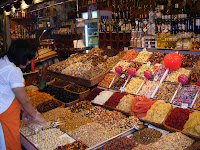
However, along Las Ramblas is the large Mercado de Bocquería, which we loved! We walked through this market in the morning to buy fresh fruit to snack on later in the day. The variety of fresh food available is incredible - you really have to see it. During the late morning and early afternoon, when people are shopping as well as eating there, it is a place of more vivacity and liveliness than the street scene at night.  After this grocery stop we joined the rest of our group on tours of two buildings designed by the modernista architect Antonio Gaudí, La Perdera/Casa Milá, and the cathedral of the Sagrada Familia. Walking along the streets of Barcelona Gaudí's influence is ubiquitous. The lamp posts along the Gran Via are designed by him and there are apartments on every block of the city displaying the modernista style, some of them designed and constructed by Gaudí himself. 


The roof of La Perdera offers an incredible view of the city, including the Sagrada Familia. It is a unique roof because the design of the chimneys and ventilation shafts give it the feeling of a large playground for children. Inside the museum, one floor has been converted into a museum displaying models of other works by Gaudí, furniture he designed, and an explanation of his inspiration from the natural world. Another floor is set up as an apartment in the late 1800s might have been decorated (very art nouveau).

The Sagrada Familia has been one of the most incredible places we have ever been. Construction began in 1882 and the projected date for completion is 2030 (but only two years

 ago it was 2020, so we'll see...) Gaudí uses figures from nature, like fruits and seashells, as if to convey the idea of heaven in a way that anybody can relate to, rather than using the elaborate style and golden ornamentation of more traditional cathedrals. Some of the towers are topped by vegetables and grains, surrounded by the words "sanctus, sanctus.. hosanna", as if to offer these goods to heaven. Viewing this cathedral is like seeing something from another world; perhaps this was the goal of architects of every cathedral but we are so far-removed from their time that they now seem common. 


We began Saturday at the Picasso museum. After seeing some of Picasso's  master works in Madrid we had really been looking forward to seeing the development of this great artist. The museum contains landscapes and portraits that he painted at the age of 15 that demonstrate such a genius ability to realistically portray what he saw. It is no wonder he felt the need to experiment with more abstract forms later in his life. After a formal education in art Picasso went to Paris and picked up a lot from other painters on the scene at the time. The influences of Seurot, Cezanne, Toulouse-Loutrec, and Matisse can be clearly scene in many of his paintings. The museum also contains a collection of his 50-some variations on Las Meninas by Diego Velázques.  One last interesting note about this museum: most of the paintings were donated by Picasso himself, an artist who actually lived to see his works become famous.


After two weeks of sight-seeing throughout Spain we realized we had actually tired a bit of nonstop touring, so we took the rest of the weekend a bit more slowly. For lunch we returned to the Mercado and bought ham, cheese, and figs that were larger and more lush than we have ever tasted before. We had a lovely picnic in our hotel before taking a train to the area of Barcelona known as Montjüic. This is the old Jewish area of the city, on the top of a hill that gives another incredible view of this enormous city. We walked through some of the gardens, preferring this tranquility to the overstimulation that the many museums of art and history offered us.


We spent our last morning in Gaudí's Parque Güell. He designed an entire hillside to be a suburban-like residence area, complete with parks and a market area. Unfortunately, Gaudí was before his time. The idea of living in a "suburb" did not yet exist and nobody was interested in moving to this (previously) remote area of the city. Now it is a unique park, filled with benches and fountains decorated with colorful tiles and a few buildings in Gaudí's usual style.


Valencia Week 1

Valencia will be a great city to live in for 4 weeks. Without all the tourism of Madrid and Barcelona, it still has just about anything one could want: museums, concert halls, shops, parks, the beach. The river that once ran through the city dried up years ago and has been converted into a huge park with sports fields, fountains, orange trees, benches, flowers, and shady fields for picnicking. We get to walk through this park every day on our way to and from school.


Our host family couldn't be more perfect! We are living with a young married couple who has a 3-year-old daughter and a 9-month-old son. They host students year-round so they are accustomed to having strangers in the house and great about talking with us a lot and correcting us. We're able to have surprisingly good conversations - our Spanish has improved so much since we arrived and we've barely even begun classes. The location of the apartment is ideal. Our room has a full-length window looking out onto the Plaza Cánovas de Castille, one of the popular places for evening tapas, beer, or coffee. We can walk to the school, downtown, or the beach in less han 30 minutes. The food is also great. We are getting to try many common Spanish dishes and our host family likes to eat a lot of fish and vegetables (just like us).